
In part 1 of this series we looked into the macronutrients (proteins, fats and carbohydrates) that make up the calorie content in dog food. In part 2 we are digging deeper to discover where those macronutrients are coming from. We will also unravel a few other mysteries that can be found on the ingredients list.
Please Note: This article is not endorsing nor criticizing any particular brand of dog food, this is just general information.
What’s in Your Dog’s Food?
The ingredients list will show everything that is in the food, although some of the words might fall into the “what the heck is that?” category. Aside from figuring out what the ingredient actually is, the challenge is that the label doesn’t specify how much of it is in there. That, my dear Watson, will require a little detective work. Ready? Ok, let me put on my Sherlock Holmes hat and we can get into it.
The Ingredients are Listed by Weight
Our first clue is that the ingredients are listed by weight in descending order. In other words, the ingredient that weighs the most will be listed first and the lightest ingredient will be last. This is helpful but there are a couple of problems to contend with.
- The actual weights of individual ingredients are not given.
- The ingredients are measured BEFORE processing.
So, the mystery continues.
Ingredients are Weighed Before Processing
Weighing the ingredients before processing means that the meat is weighed raw. This is a critical part of the equation because raw meat contains 60% to 75% water, most of which will evaporate after being processed into kibble. Meanwhile, the grains (wheat, rice, corn, soybeans, oats, etc.) are weighed in their dry state, so they will not lose moisture after being processed. In other words, the meat will shrink and the grains will not. So, picturing the food on the ingredients list as it would appear on your dinner plate would be a huge mistake.
Ok, for those who have never cooked chicken and rice from scratch, let me help you out. After cooking, the chicken shrinks and the rice grows. If you were to portion out the raw chicken and dry rice without knowing this little fact your reaction to your cooked meal would be something like, “Wow! Can I please have some chicken to go with this ginormous plate of rice?”
Ok, let’s continue.
The #1 Ingredient Myth
The ingredients being listed by weight has led to the erroneous notion that the number one ingredient is what the food is primarily made of.
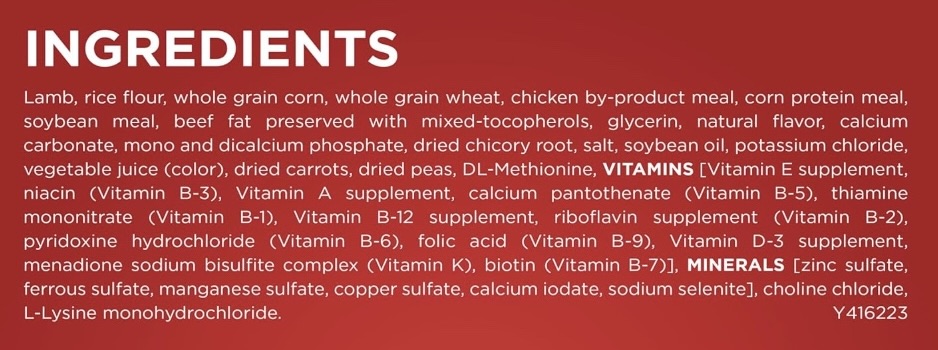
For example: The label that I chose as an example boasts, in giant bold letters, REAL LAMB #1 INGREDIENT.
It’s not a lie. Lamb is the number one ingredient but that does not mean it’s the primary ingredient.
If you recall, the lamb was weighed before processing which begs the question,
“Where would lamb be on the list had it been weighed after processing?”
I’m no math wizard but we know it would be 60-75% lighter, which would almost certainly knock it out of the #1 spot, possibly by a lot.
Moral of the story, the #1 ingredient doesn’t tell us much. We need to dig deeper.
Checking The First Five Ingredients
A lot of consumers have gotten savvy to the number one ingredient myth, which has led to another common recommendation, which is looking at the first five ingredients. Obviously, it’s better to read the entire list but let’s follow the “check the first five” trend and see where it gets us.
The Top Five Ingredients (Taken from our sample label. See photo at top of article)
- Lamb
- Rice flour
- Whole grain corn
- Whole grain wheat
- Chicken by-product meal
We can derive from this that there is more lamb than rice flour, or at least there was before processing. After that we can see that there’s more rice flour than whole grain corn and so on. What we don’t know is, how much more?
Please, stay with me here because I am going to show that there could potentially be very little lamb in this “lamb and rice” dog food.
“How can that be true if there’s more lamb than anything else?”
Elementary my dear Watson. There is more lamb than any other single ingredient, not the sum of all the other ingredients.
For example: Technically, there could be 10 units of lamb, 9 of rice, 8 of corn, 7 of wheat and 6 of chicken by-product meal.
If that were the case, there would be 30 units of the other four ingredients (9+8+7+6 = 30)
compared to only 10 units of lamb. Obviously, that is far from being mostly lamb and it would actually be mostly made of grains.
But wait, there’s more…
Let’s not forget that lamb shrinks by at least 60% after processing, which would bring it down to 4 units, possibly even less.
That would mean that the lamb content could possibly be even less than the chicken by-product meal. In fact, if all products were weighed in their dry state, lamb might not even make it into the first five ingredients.
“But you just made up those numbers!”
That’s true, I’m simply pointing out what could possibly be the case according to the rules of the labeling game.
At the end of the day, we don’t have the weights of the ingredients, so it’s a guessing game. However, if we refer to part 1, we know that this product contains 58% carbohydrates. If we combine that data with the fact that lamb contains 0 grams of carbohydrates, we can make the educated guess that this product contains less “real lamb” than the packaging suggests.
Now, let’s see if we can solve the mystery of the sneaky chicken.
What is Chicken By-Product Meal?
Well, it’s made from chicken, which might seem a little sneaky to the customer who thought they were purchasing a bag of “lamb and rice” dog food.
Aside from there being a sneaky chicken stowaway in our lamb dog food, the two terms that are important here are by-product and meal and the combined term, by-product meal. Let’s look at these two terms separately:
By-Product: By-products refer to the edible parts that remain after the muscle meat has been removed. This includes things like liver, spleen, lungs, kidneys, feet, head, neck, bones, intestines, fatty tissue, undeveloped eggs and other non-muscle parts but does not include any inedible materials such as feathers, hooves, teeth and hair.
“Yuck!”
I know, I know, it sounds kind of nasty but, for perspective, folks in the raw, natural, holistic and home cooked pet food communities often go out of their way to feed a lot of those “nasty” ingredients because they mimic the dog’s ancestral diet. Some refer to this as “nose to tail” feeding.
Meal: Meal refers to a concentrated form of protein created by rendering and drying animal tissues (meat and/or by-products) to remove most of the moisture. The rendering process involves high heat to remove moisture, separate fat from protein and ensure safety. This process results in a dry, fine powder that is rich in protein and nutrients. I suppose a positive way to look at it is that it’s sort of like a doggie version of a protein powder.
Hold on now. Before all you gym bros get too excited, there’s good news and bad news about this “meal” situation.
- The good news is that meals retain their protein concentration and do not shrink significantly during processing, the way fresh meat does. This ensures a higher protein content in the final product. For example, chicken meal contains about 62-70% protein by weight, compared to fresh chicken, which is only about 29% protein due to its high moisture content.
- The bad news is that rendering can alter or destroy some natural enzymes and proteins. The rendered “meal” also gets a double whammy of processing. It is a highly processed product to start with and then it gets processed again after being added to the dog food blend.
In summary, chicken by-product meal is a dry, highly processed, concentrated protein powder made from the chicken carcasses after the muscle meat has been removed. And, because it is a dry source of protein, it is not subject to the same loss of mass that we discussed previously regarding the questionable lamb content in this bag of dog food.
So, my dear Watson, it appears that there could possibly be just as much, if not more, chicken than lamb in this “lamb and rice” dog food. Beware of sneaky chickens!
Up next, label trickery and the salt divide.
Anything Listed After Salt = Less Than 1% of Total Content
A principle commonly referred to as the “salt divide” is based on the fact that salt (sodium chloride) is typically included in dog food at around 1% or less, as regulated by the Association of American Feed Control Officials (AAFCO). Hence, any ingredient listed after salt must constitute less than 1% of the food by weight.
This means that the majority of what’s listed after salt will likely be vitamins, minerals or other additives that only require trace amounts to be effective. However, the savvy consumer should be aware of the potential for label trickery that lies beyond the salt divide.
For example: If blueberries are listed after salt, they contribute less than 0.17 grams per day’s food for a 30-pound dog, which is roughly one-tenth of a blueberry per day.
“Why would they even bother putting it in there?”
That’s a great question. I suppose it’s possible that they believe one-tenth of a blueberry has enough nutrition to be worth the trouble. It’s also possible that it has something to do with the regulation that allows anything on the ingredients list to be represented with photos or bold print on the packaging.
In other words, one tenth of a blueberry is enough to put “Made with Real Blueberries!” and a color photo of a mountain of fresh blueberries on the packaging.
Sneaky chickens and blueberry trickery, what has the world come to?
The Unpronounceables
Ok, let’s wrap up our ingredients list conversation by highlighting a handful of those mysterious and unpronounceable words that you might find on a dog food label.
Mixed tocopherols: Mixed tocopherols are a blend of different natural forms of vitamin E. They are commonly used as a natural preservative to prevent fats and oils from oxidizing and going rancid, thereby extending the shelf life of products.
Glycerin: Glycerin is a colorless, odorless, and sweet-tasting liquid that occurs naturally as part of tri-glyceride fats and can also be synthetically derived. It is commonly used in dog food to prevent it from drying out or becoming stale. It also contributes to the shelf life of the product by inhibiting the growth of bacteria and mold. Additionally, glycerin acts as a natural sweetener.
Calcium Carbonate: Calcium carbonate is a chemical compound commonly found in rocks, shells, and eggshells, and is widely used in dog food as a source of calcium. Beyond its nutritional role, calcium carbonate also functions as a preservative and a color retention agent, helping to extend shelf life and maintain the product’s appearance.
Mono and Dicalcium Phosphate: Monocalcium and dicalcium phosphate are both inorganic phosphate salts used as mineral supplements in dog food.
DL-Methionine: DL-Methionine is a synthetic form of the essential amino acid methionine. It is commonly added to dog food to ensure adequate levels of this vital amino acid, particularly in diets with low meat content or high plant-based ingredients where natural methionine may be insufficient. (Note: the inclusion of this ingredient reinforces our previous suspicions that this product may have very little “real lamb” in it.)
Natural Flavor: Natural flavor refers to a substance derived from plant or animal sources that is used to enhance the taste and aroma of the food. Manufacturers use natural flavors to improve palatability, especially when the base ingredients may be less appealing or when the food contains lower-quality components that need masking. For example, a small amount of chicken digest can create a “chicken-flavored” product without including actual chicken meat. The specific source or processing method is not required to be disclosed, which can be a concern for dogs with allergies or sensitivities.
Et Cetera, Et Cetera, Et Cetera: A lot of the odd words on the rest of the list are vitamins and minerals. You could simply be comforted by that or you could do a deep dive into the details such as sourcing, processing, bioavailability, synthetic vs natural, methylation, chelation, etc.
Conclusion
I hope you found this article insightful, thought provoking and maybe even a little inspiring. It would make my day to learn that it inspired you to do more research into canine nutrition, commercial dog food and/or other canine nutrition options such as home cooking, raw feeding, the carnivore diet, etc.
For a deeper dive into the ingredients list on whatever dog food you are currently using or thinking about using, simply type, “What is (insert ingredient name) and why is it in dog food?” into any search engine or your favorite AI app. It should give you a decent summary almost instantly. To go even deeper you can ask follow up questions or follow any recommended links.
Bon Appetit!
Chad Culp – Certified Dog Trainer, Canine Behavior Consultant, Certified Holistic Chef for Animals and Owner of Thriving Canine.
© Thriving Canine 2026
We offer in-person training in the San Francisco Bay Area as well as virtual consults anywhere in the world.
Thriving Canine University private Facebook group. (please read the rules before joining)
Related Topics
Deciphering Dog Food Labels part 1: The Macronutrients (Proteins, Fats, Carbs)